
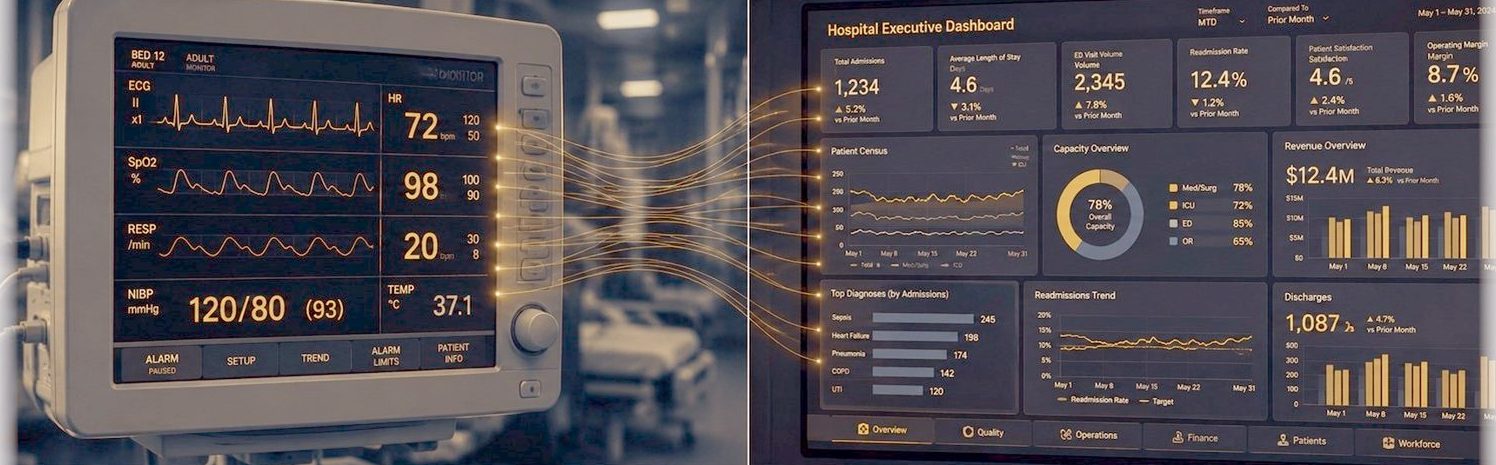
Vital Signs of an Operating System
Chapter 2 Bedside Questions · 7 questions · about 7 minutes
Leaders either ignore operational metrics for quarters or treat the number itself with targets and incentives, while the underlying system disease progresses. Dashboards are unaudited, thresholds reward snapshots and hide slopes, siloed owners treat one disease three times badly, and metric targets invite gaming.
Vital signs: operational metrics show whether the organization is compensating, decompensating, or coding, but a vital sign is ‘a scream, not a full sentence.’ Never ignore one, never treat one; do a review of systems across five organ systems.
Answer as your executive team would, with the evidence in hand. Each question has a factual answer in a system you already own.
Which of the five systems (flow, workforce, communication, documentation, data integrity) worries you most, and what is its vital-sign trend over the last 6 months?
Add a note: where is the evidence, or who owns it?
Who governs metric definitions? Are they stable across departments, or is each leader looking at a slightly different number?
Add a note: where is the evidence, or who owns it?
When did a senior leader last walk the workflow behind one of those numbers, with a stopwatch and without the dashboard?
Add a note: where is the evidence, or who owns it?
Which operational metrics are tied to executive or departmental incentives, and has a documented differential diagnosis ever been done for any of them?
Add a note: where is the evidence, or who owns it?
Has any metric improved in the past year while the frontline experience of the same workflow worsened? How would you detect that?
Add a note: where is the evidence, or who owns it?
Have your operational dashboards been audited against the actual workflow they claim to measure in the last 12 months?
Add a note: where is the evidence, or who owns it?
Is your Diagnostician (CMIO or equivalent) seated at the operations meeting as a peer, or invited as a guest?
Add a note: where is the evidence, or who owns it?
A reflection tool from the book, not a validated diagnostic test or benchmark. Your answers and notes stay in this browser unless you choose to send them. Please don't enter patient information.
A vital sign is a scream, not a full sentence. It tells you something needs your attention. It never tells you why.
The Diagnostician, Chapter 2