Everything an editor or host needs
Bios in four lengths, a fact sheet, story angles with sample questions, endorsements and images. For interviews and review copies, use the contact form.
Thomas Powell, MD MS, is a physician and career Chief Medical Information Officer with over twenty-five years in clinical, academic and industry leadership. He owns CMIO, LLC, which provides interim executive services, consultation and the Diagnostician method. He is the author of The Diagnostician (November 2026).
Thomas Powell, MD MS, is a physician and applied clinical informaticist who has spent more than two decades in clinical informatics leadership, including Chief Medical Information Officer roles since 2010. He owns CMIO, LLC, which provides interim executive services, consultation, project support, and the Diagnostician method, which applies the physician's clinical method to the health system itself. He speaks, writes and mentors physician informaticists nationally. His book, The Diagnostician: American Healthcare Is Sick, Misdiagnosed, and Getting Worse; It's Time to Call the Doctor, carries forewords by David Lubarsky, MD, MBA, and W. Ed Hammond, PhD.
Dr. Thomas Powell has spent more than two decades in clinical informatics, much of it as a Chief Medical Information Officer, the physician responsible for making clinical technology actually serve patients. His new book, The Diagnostician, argues that American healthcare has been treated for twenty years without a diagnosis. Today he's going to make one.
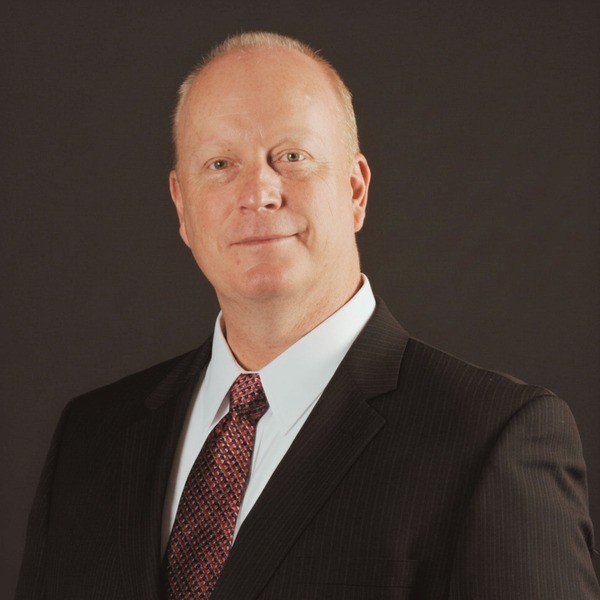
Title: The Diagnostician
Subtitle: American Healthcare Is Sick, Misdiagnosed, and Getting Worse; It's Time to Call the Doctor.
Author: Thomas Powell, MD MS
Forewords: David Lubarsky, MD, MBA; W. Ed Hammond, PhD
Publisher: CMIO, LLC Publishing
Published: November 3, 2026
Editions: Kindle, paperback, hardcover, premium color hardcover
- Why twenty years of health IT arrived without a diagnosis
- The CMIO title versus the CMIO function
- Governing AI the way we govern drugs
- Alert fatigue as a patient-safety problem
- What boards should ask about technology
- The informatics workforce no one is training
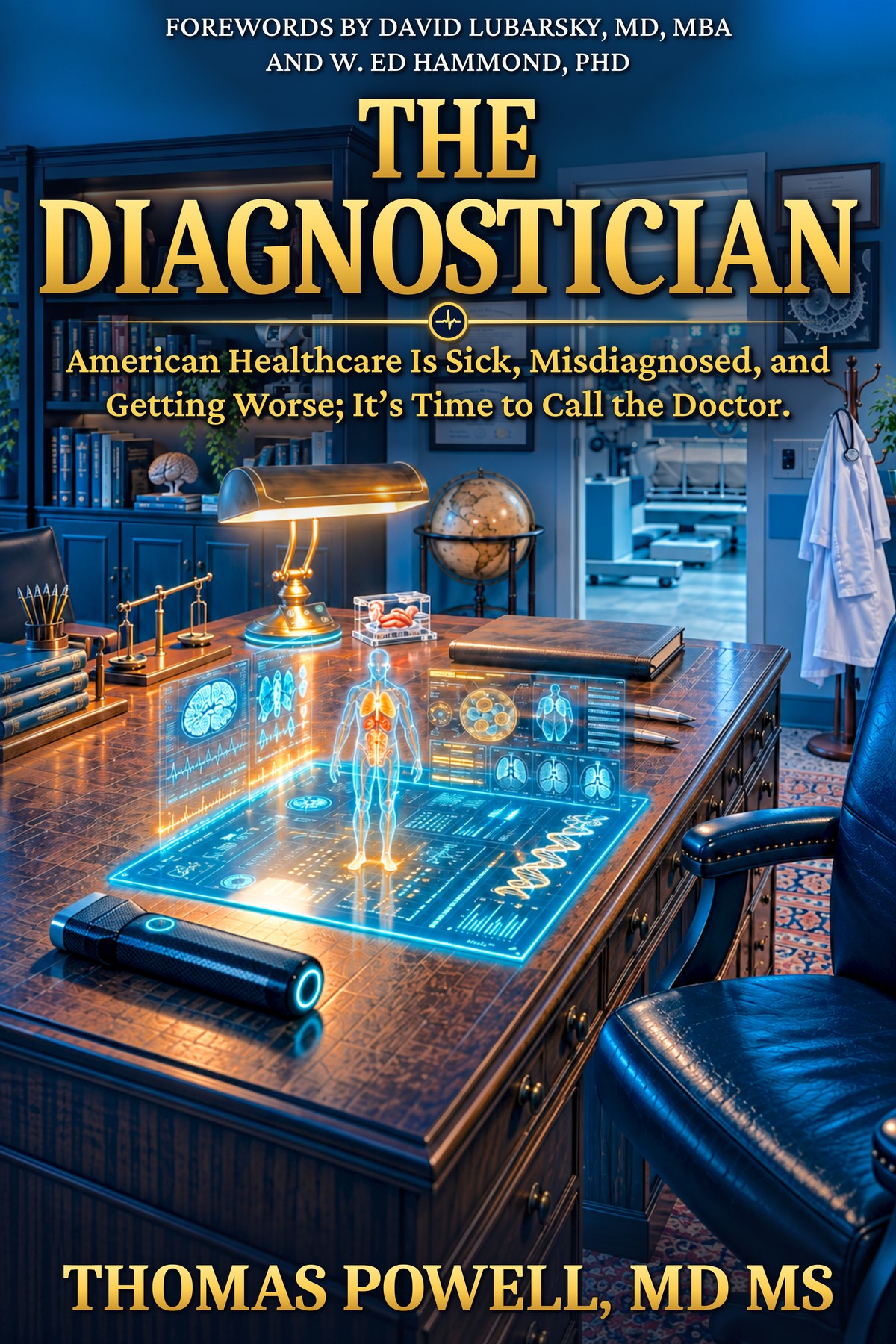
Thomas Powell, MD, MS, is a physician executive and career Chief Medical Information Officer. He trained in clinical informatics at Duke University as a National Library of Medicine fellow, mentored by W. Ed Hammond, and earned his MD at the University of Texas Medical School at San Antonio.
At the University of Miami Miller School of Medicine he was Assistant Professor of Anesthesiology and Director of Anesthesia Informatics, leading a multi-hospital anesthesia information system for the country's largest anesthesia residency. As CMIO of Miami Children's Hospital (now Nicklaus Children's) he led the move from paper to Cerner across 38 pediatric subspecialties. As CMIO and Associate Vice Chancellor at the University of Arkansas for Medical Sciences he led the enterprise transition to Epic across the hospital and 43 clinical groups, then created Arkansas's first clinical informatics master's and doctoral programs. He served as Medical and Executive Officer of the Arkansas Office of Health Information Technology and the state health information exchange, and as Vice President and CMIO of Aspirus Health, an 18-hospital system.
Through CMIO, LLC, founded in 2019, he provides interim executive leadership and advises health systems, technology companies and payers on clinical informatics, EHR strategy and clinical AI governance.
His book, The Diagnostician (November 3, 2026), applies the physician's clinical method to the health system itself: the history, the examination, a working diagnosis committed to in writing, and a treatment plan. Every chapter ends with Bedside Questions, and all seventeen are free as exams at thomaspowellmdcmio.com. The book carries forewords by David Lubarsky, MD, MBA, and W. Ed Hammond, PhD. He lives in Little Rock, Arkansas.
Title: The Diagnostician
Author: Thomas Powell, MD MS
Forewords: David Lubarsky, MD, MBA; W. Ed Hammond, PhD
Publisher: CMIO, LLC Publishing, Little Rock, Arkansas
Published: November 3, 2026
Length: 420 pages, 17 chapters, 4 appendices
ISBNs: Kindle and EPUB 979-8-9961314-2-6 · Paperback 979-8-9961314-1-9 · Hardcover 979-8-9961314-0-2 · Premium color hardcover 979-8-9961314-3-3
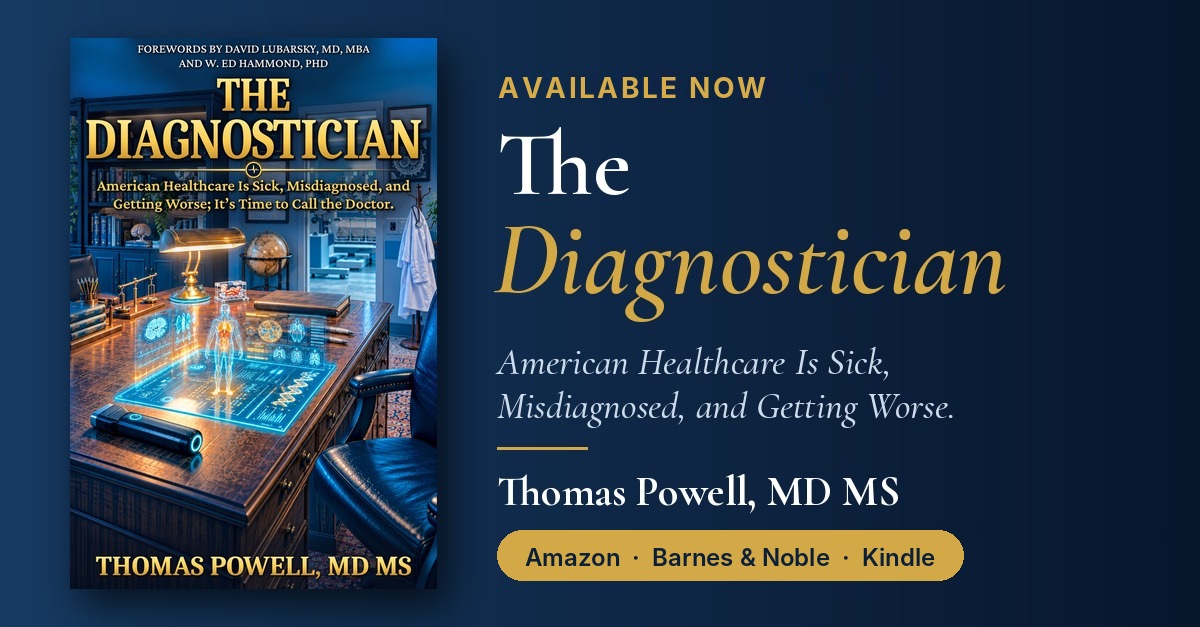
Buy: Amazon · Barnes & Noble · Kindle
Free companion: seventeen chapter exams at thomaspowellmdcmio.com/exam-room
Media contact: thomas@thomaspowellmdcmio.com
“It is the rare book that takes a history, examines the patient, reads the data honestly, and reasons its way to a treatment. It is rarer still in being right.” David A. Lubarsky, MD, MBA, President and CEO, WMCHealth
“This is one of the best books I have read. Dr. Powell writes from the perspective of a clinician and an informaticist, and he clearly knows what he is talking about.” W. Ed Hammond, PhD, Director, Duke Center for Health Informatics
“The Diagnostician is a must-read for everyone in healthcare, and especially for those searching for solutions to a broken system.” Jacques Orces, DO, MS, FAAP, VP and CMO, Nicklaus Children's Hospital
What each chapter covers
- Introduction: Naming Healthcare's Disease. Why two decades of technology spending have not fixed American healthcare. The problem is a missing diagnosis and no accountable physician leader, not a shortage of technology.
- Chapter 1: The Chief Complaint, History, and Physical. How technology chosen by vendors, mandates and executive impulse degrades the visit between clinician and patient, and the cascade that follows: cognitive load, safety risk, quality drift and lost money.
- Chapter 2: Vital Signs of an Operating System. Reading hospital operating metrics such as boarding, length of stay and staff turnover the way a physician reads vital signs: as warnings to investigate, not numbers to chase with targets.
- Chapter 3: Laboratory Markers of Survival. The money. Where America's $5.3 trillion goes, why operating margin is a symptom rather than a diagnosis, and how documentation, quality payment and technology costs drive it.
- Chapter 4: The EHR: An Imaging Modality for Information. Why the electronic health record is a diagnostic instrument, not a cure, and why organizations that spent hundreds of millions on go-live never funded the people who make it pay back.
- Chapter 5: Hemolyzed Specimens: When the Data Are Corrupt. Data quality. How numbers pass through six to eight unowned transformations before an executive sees them, and what corrupt data cost in denials, rework, burnout and unreliable AI.
- Chapter 6: Iatrogenic Harm: When the Treatment Causes Harm. Patient harm caused by health IT itself: alert fatigue, wrong-patient orders, missed results and algorithm errors, and why no one in most hospitals owns technology safety.
- Chapter 7: The Multidisciplinary Care Conference: Team Medicine. Governance. Why parallel executive committees produce minutes instead of decisions, and how the tumor board model of one chair and one written plan applies to running a health system.
- Chapter 8: Investing in the Diagnostician: Name, Form, and Function. The economics of the CMIO role. Roughly 7 in 10 hospitals have the title, few give it the conditions to work, and the chapter prices a real informatics program against $867.5 billion a year in measured waste.
- Chapter 9: Clinical Technology Decisions: Who Should Make Them. Who should decide alert logic, order sets, documentation and AI deployment, and why clinical decisions made by analysts and vendors need the same scope-of-practice rules as medicine.
- Chapter 10: A Discipline in Disarray (The Profession of Clinical Informatics). The profession behind the title: board certification, the many routes to becoming a CMIO, and why so few of them produce the physician leader organizations need.
- Chapter 11: The Working Diagnosis (Making a Commitment). Committing to a diagnosis in writing. Why vendor choice explains little of EHR safety performance, why clinicians spend nearly 2 hours in the EHR for every hour with patients, and what fragmented governance costs.
- Chapter 12: Clinical Decision Support (The Impact of Crying Wolf). Alert fatigue. Override rates as high as 96%, alert libraries that grow without owners, and how to aim decision support at the orders most likely to cause harm.
- Chapter 13: Artificial Intelligence Is Here: Reading the Label. Clinical AI that reached patients without trials, with 96.5% of AI devices cleared through the FDA's 510(k) pathway, and how hospitals should validate, monitor, own and stop it.
- Chapter 14: Telehealth and Digital Health: The Route of Administration. Telehealth as a route of administration: who it reaches and who it misses, where remote teams improve outcomes, and the Medicare flexibilities set to expire at the end of 2027.
- Chapter 15: The Clinical Method Applied: Caring for a Patient. A full worked case: running a health system improvement the way a physician works up appendicitis, from history and examination to a written diagnosis, orders, follow-up and maintenance.
- Chapter 16: The Prognosis: Comorbidities Arriving on Schedule. Four pressures arriving on schedule: value-based payment, AI outpacing governance, a physician shortage of up to 86,000 by 2036, and the national interoperable record, and why each one depends on informatics.
- Chapter 17: Referral to a Higher Level of Care: The National Infrastructure for the EHR. The national problems no single hospital can fix: patient identity, a common clinical language and a record that follows the patient, and what the HITECH Act got wrong.
- Conclusion: The Discharge Plan. What recovery looks like a few years out: what to do now, what to do over time, and the warning signs that progress has stalled.
- Appendix A: The Six Conditions for the Diagnostician. A ten-minute screen that scores whether an organization has a working informatics function or only the title.
- Appendix B: The Comprehensive Informatics Assessment. The full examination: thirty-five items across seven informatics domains, an afternoon's work that produces a map of where the organization is sick.
- Appendix C: The Burden of Healthcare's Financial Disease Calculator. A worksheet that converts the national figures into what the absence of a working informatics function costs one organization each year.
- Appendix D: The AI Model Inventory. One form for every AI model in use: owner, local validation, monitoring and stopping rules. A form that cannot be completed is the finding.
Five stories, with questions to ask
Twenty years of health IT without a diagnosis
Why have hospitals spent two decades buying technology without measurable results? What should a board ask before the next purchase?
AI reached patients without a trial
96.5% of AI-enabled devices reached the market through the FDA's 510(k) pathway (Loganathan et al., 2026). What does clearance prove, and what should a hospital test on its own patients?
The CMIO has the title and not the job
Roughly 7 in 10 hospitals have a CMIO title (HIMSS, 2019). What is the difference between the name, the form and the function of the role?
Alert fatigue is a patient-safety problem
Physicians override drug alerts 49% to 96% of the time (Van der Sijs et al., 2006). Who in a hospital has the authority to turn an alert off?
Bad data, confident decisions
Data are fit or unfit for a stated use (Kahn et al., 2016). How does a number on a board slide go wrong between the bedside and the boardroom?
Review copies and interviews: contact form or thomas@thomaspowellmdcmio.com.